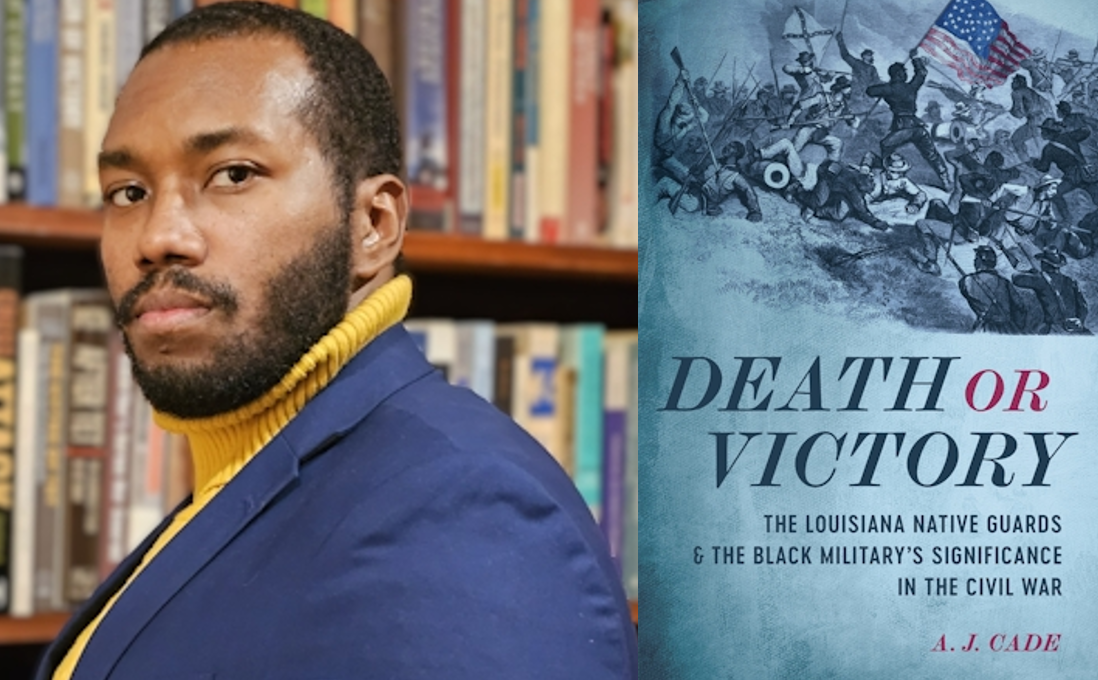
Second Thursday Lecture Series:
Death or Victory: The Louisiana Native Guards and the Black Military’s Significance in the Civil War with A. J. Cade
Second Thursday Lecture Series:
Death or Victory: The Louisiana Native Guards and the Black Military’s Significance in the Civil War with A. J. Cade
Join us for a virtual evening with A. J. Cade as he discusses his upcoming book Death or Victory: The Louisiana Native Guards and the Black Military’s Significance in the Civil War (LSU Press, February 2026). This program is sponsored by the Friends of the Cabildo as part of the Second Thursday Lecture Series. It is free and open to the public, but registration is required. The program will take place on Zoom. Please register here and a link will be emailed to you on the day of the lecture.
NOTE: Due to Mardi Gras, this lecture will be pushed to the third Thursday.
About the Book
A. J. Cade’s Death or Victory offers the first in-depth history of the Louisiana Native Guards, pioneering African American regiments within the Union army. Originating as a division of the New Orleans Home Guards in May 1861, the Native Guards consisted of free Black and Creole men who leveraged the city’s established military customs to gain entry into the Home Guards. Although not officially part of the Confederate forces, their involvement compelled the federal government to contemplate forming a similar regiment, setting the stage for their transition to the Union army the following year.
Cade’s research highlights the Native Guards’ crucial role as a testing ground for Black participation in the Civil War. Abraham Lincoln, the War Department, and the entire nation regarded these early regiments as an experiment in understanding the implications of Black service. The Native Guards exceeded expectations, engaging in significant battles and sieges. Their achievements paved the way for broader Black involvement in Louisiana and eventually throughout the Union army. Prominent figures such as Frederick Douglass cited the Native Guards as evidence of Black Americans’ entitlement to full citizenship and postwar freedom, an opinion later echoed by Lincoln. Cade’s work challenges existing Civil War narratives by shedding light on the overlooked contributions of the Louisiana Native Guards, rectifying misconceptions, and highlighting Black and Creole individuals who fought for their nation.
In addition to revising Civil War historiography, Cade’s study also contributes to a more nuanced understanding of race and class in nineteenth-century New Orleans. Cade shows how the Native Guards reflected the unique racial dynamics of the city, where free Black and Creole men of color had long enjoyed a degree of social and economic autonomy. These men were often educated, property owning, and deeply invested in the city’s civic life. Their service in the Native Guards was not just about fighting for the Union; it was also about asserting their rights as citizens and challenging the racial hierarchies that sought to deny them full participation in American society. By examining the motivations and experiences of these men, Cade provides a compelling portrait of a community that defied easy categorization and played a pivotal role in shaping the course of the Civil War.
About the Author
A. J. Cade is a retired United States Marine and executive council member with the Association for the Study of African American Life and History. He is a professional military historian who holds a doctorate in history from George Washington University.