Second Thursday Lecture Series
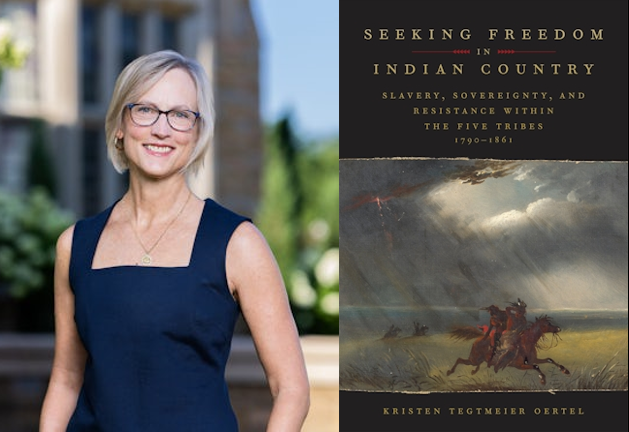
Seeking Freedom in Indian Country: Slavery, Sovereignty, and Resistance within the Five Tribes, 1790–1861 with Kristen Tegtmeier Oertel
Second Thursday Lecture Series
Seeking Freedom in Indian Country: Slavery, Sovereignty, and Resistance within the Five Tribes, 1790–1861 with Kristen Tegtmeier Oertel
Join us for a virtual evening with Kristen Tegtmeier Oertel as she discusses her new book Seeking Freedom in Indian Country: Slavery, Sovereignty, and Resistance within the Five Tribes, 1790–1861 (LSU Press, June 2026). This program is sponsored by the Friends of the Cabildo as part of the Second Thursday Lecture Series. It is free and open to the public, but registration is required. The program will take place on Zoom. Please register here and a link will be emailed to you on the day of the lecture.
About the Book
Kristen Tegtmeier Oertel’s Seeking Freedom in Indian Country is the first comprehensive study of African chattel slavery within the Five Tribes: the Cherokee, Chickasaw, Choctaw, Muscogee (Creek), and Seminole Nations. Oertel examines how chattel slavery functioned among all Five Tribes before and during the removal process, how the tribes reconstituted slavery post-removal in Indian Territory, and how enslaved Black people promoted freedom-seeking strategies at each stage. Furthermore, her work considers how the conflict over slavery in Indian Territory contributed to the larger national debate over slavery’s fate on the eve of the Civil War.
Historians have examined how the practice of African enslavement emerged within one or two tribes, how forced migration affected slavery within particular nations, and how the debate over slavery divided multiple Indigenous nations. Oertel, however, is the first to examine Indian Territory as a whole, its significance to the sectional debates, and its role as an incubator of emancipation policies in the United States. Knitting together these individual tribal narratives and supplementing them with extensive primary research on how slavery functioned across Indian Territory, she integrates Indian country into the antebellum march toward the Civil War.
Seeking Freedom in Indian Country joins a rising chorus of studies that integrate southern and western history, which, by default, also pulls together the history of the so-called Indian Wars with the Civil War. Oertel suggests that we cannot fully understand the causes of the Civil War without also considering the changes brought about by the forced removal of Indians. She argues that settler colonialism and the expansion of African chattel slavery together set the stage for sectional conflict to explode in the West. Ironically, both Indigenous resistance to settler colonialism and Black resistance to slavery challenged white supremacy in ways that foretold the end of slavery but also furthered the settler colonial project.
About the Author
Kristen Tegtmeier Oertel is Mary F. Barnard Professor of Nineteenth-Century American History at the University of Tulsa. She is most recently the author of Harriet Tubman: Slavery, the Civil War, and Civil Rights in the Nineteenth Century.