Early Reconstruction: Shifting Power, New Laws, and Racial Tensions

1866–1870

Online Exhibitions

 
After the Civil War, formerly enslaved Americans and their allies kept fighting for laws that would protect basic rights for all men, no matter their race. Many former Confederates feared those changes. They believed growing Black political power threatened white men’s social standing and control of the government. Across the South, groups of white citizens tried to stop newly freed Black people from gaining political influence and economic independence. In Louisiana, local laws were passed in 1865 and 1866 known as the Louisiana Black Codes[1]. These laws limited where Black Americans could travel, where they could work, and whether they could own guns. New federal acts and constitutional amendments tried to address these discriminatory laws, and so did newly elected state governments that included Black representatives. As the political and legal landscape changed, racially motivated anger among white residents erupted into violence. 

Mechanics’ Institute Massacre

Unease and anger grew among white former Confederates as Black residents worked toward obtaining equal treatment under the law. The newly freed Black population moving from rural plantations into urban areas created more competition for housing and employment in Southern cities, placing more stress on low-income white households. In Memphis, a fight between three Black men and four white police officers on April 30, 1866, stoked existing racial tensions and set off three days of riots led by white residents and police officers. The Memphis riots[2] killed forty-eight Black residents and two white men and destroyed more than sixty homes, schools, and churches in Black communities. Just twelve weeks later, a similar outburst of violence shook New Orleans, known as the Mechanics Institute Massacre.
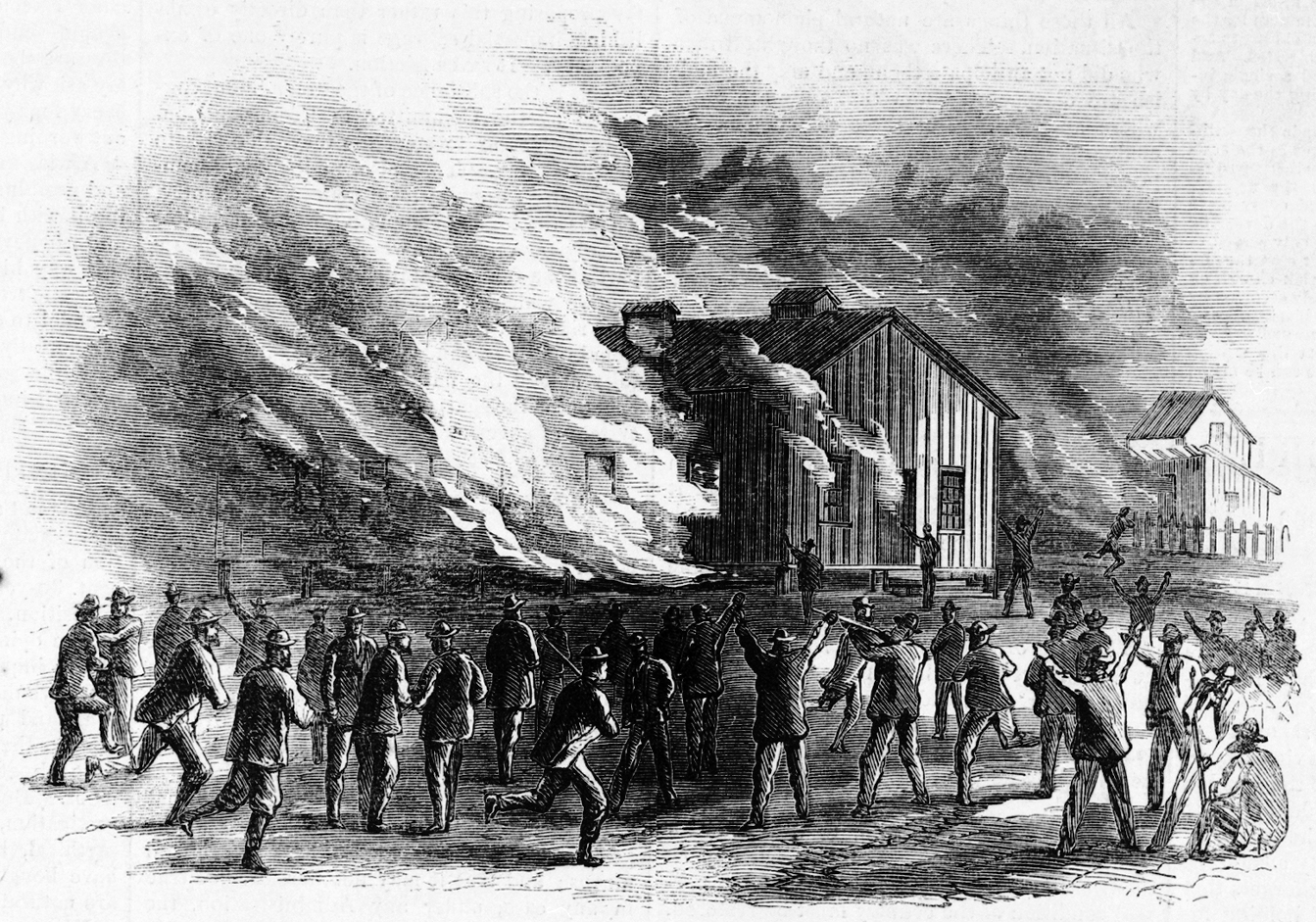
Black-and-white illustration of a crowd of men gathered around a wooden building engulfed in flames, some raising arms or weapons as smoke billows into the sky.
Alfred R. Waud, “Scenes in Memphis, Tennessee, during the riot,” 
Harper’s Weekly, illustration, (1866 May 26), from Library of Congress 
Prints and Photographs Online Catalog


Black activists in Louisiana advocated for the right to vote, particularly through the Black-owned newspapers L’Union[3] and the New Orleans Tribune[4]. At this time, Louisiana was controlled by a federally backed Republican state government. In response to their activism—and to ensure more voter support for the Republican government—the Governor of Louisiana reopened the 1864 Louisiana constitutional convention. The purpose was so that the newly racially integrated convention could change the State Constitution to give Black men the right to vote.
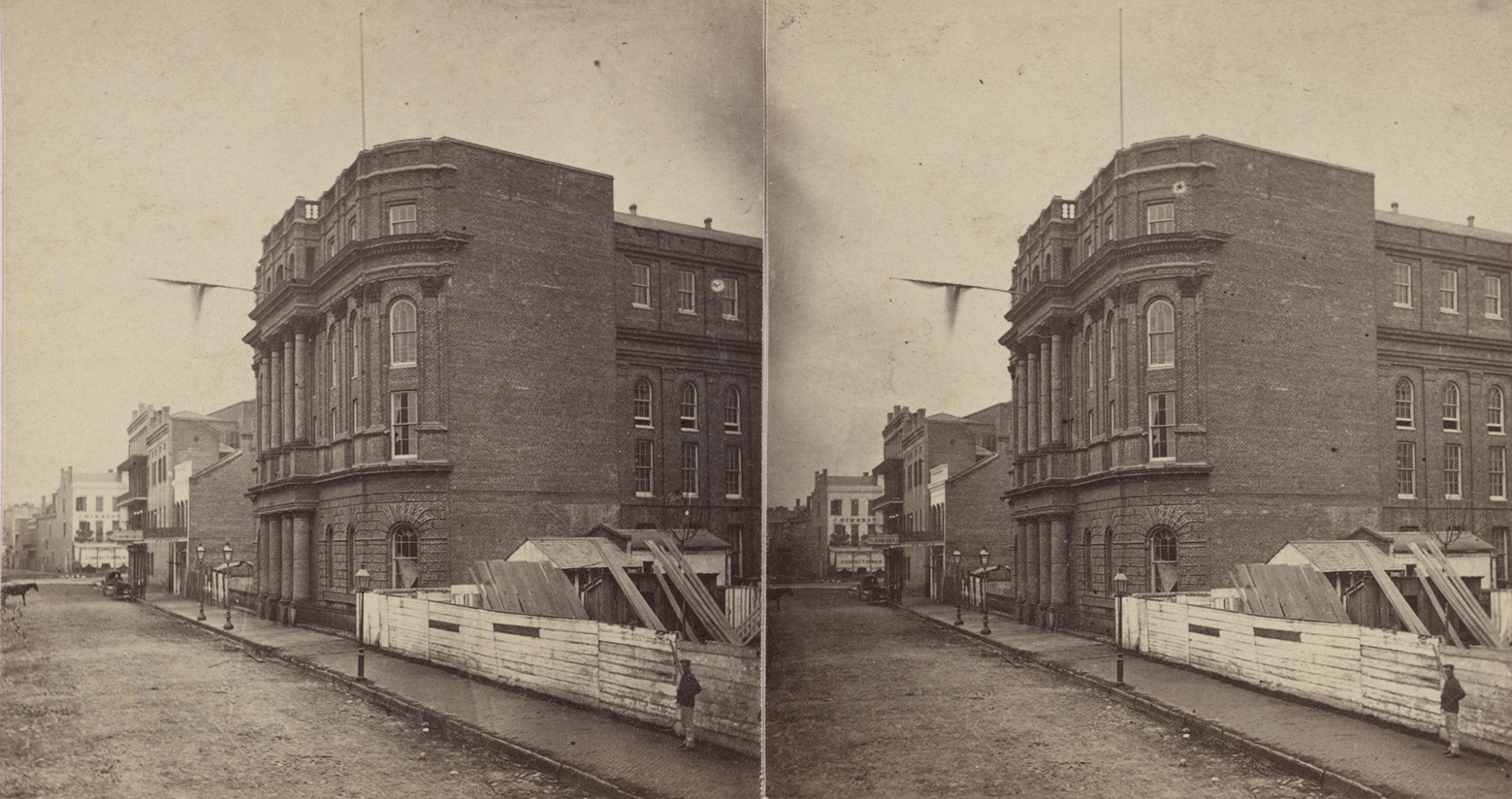
Ornate 1868 lithograph titled “Extract from the Reconstructed Constitution of the State of Louisiana,” featuring a central portrait of Lieutenant Governor Oscar J. Dunn surrounded by smaller oval portraits of Black delegates to the constitutional convention, with American flags, an eagle, and decorative scrollwork.
Lilienthal’s Photographic Establishment, “Mechanic’s Institute,
New Orleans, Louisiana,” stereograph, between 1860 and 1870, 
from Library of Congress Pints and Photograph Division


Black and Creole activists in New Orleans organized a rally on July 27, 1866 to support the convention. Three days later, delegates of the convention met at the Mechanics’ Institute[5] in the downtown New Orleans business district, just off Canal Street. Outside the building, white bystanders harassed a parade of Black Civil War veterans. The confrontation became violent. The mob of white citizens grew and was joined by police officers. Together, they murdered Black people in the streets[6] and then attacked the convention[7] itself. After six hours of chaos, the military declared martial law. The mob killed approximately 48 Black Americans and three white Republicans.  
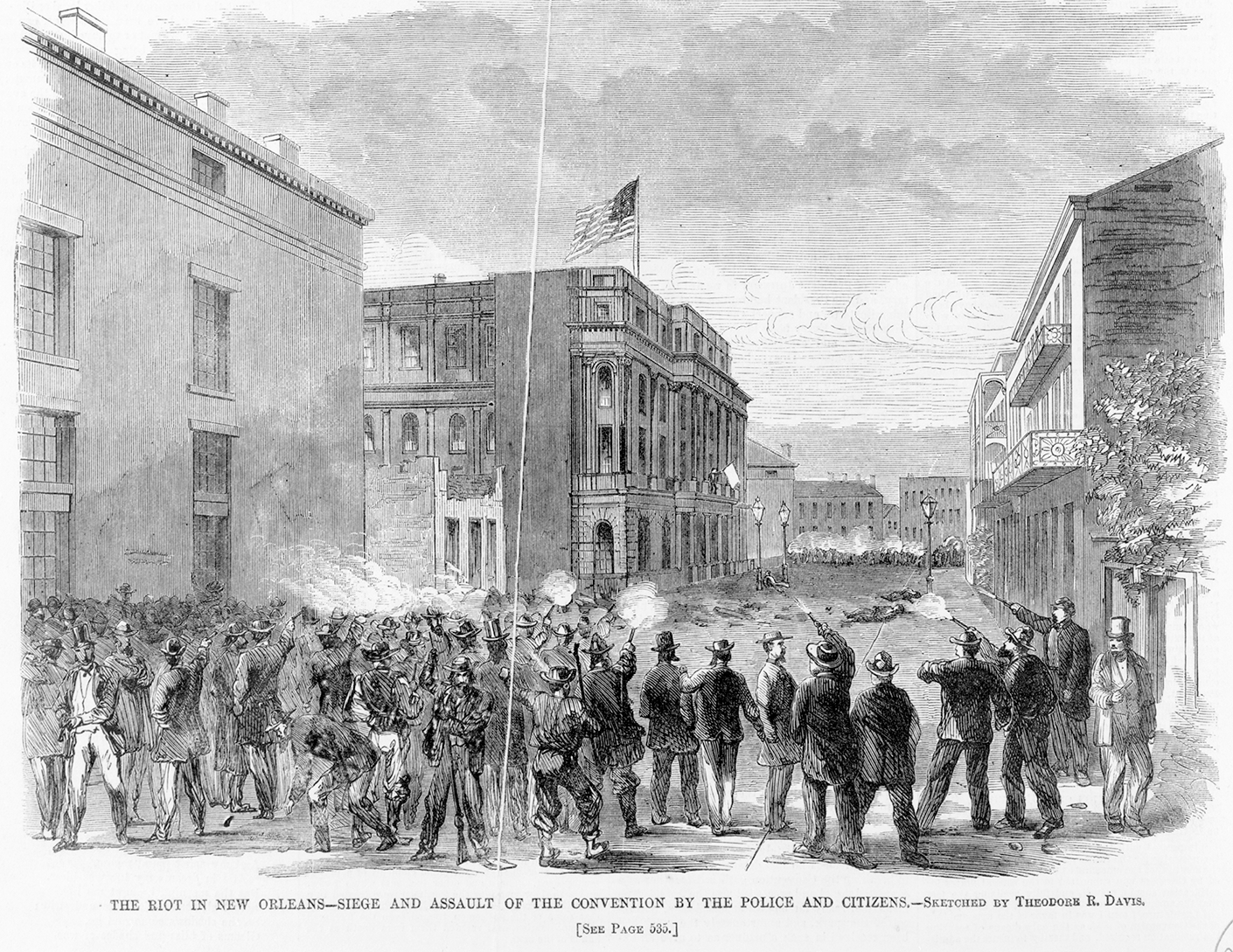
Black-and-white illustration of armed men and police clashing in a New Orleans street during the 1866 riot, with gunfire, smoke, and bodies visible as a crowd advances toward a large civic building flying an American flag.
Theodore R. Davis, “The Freedmen’s procession marching to the institute – the 
struggle for the flag,” Harper’s Weekly, illustration, (1866 August 25), from 
Library of Congress Prints and Photographs Online Catalog
Black-and-white illustration of armed men firing guns inside a large hall during the 1866 New Orleans Mechanics’ Institute riot; figures fall or flee as smoke fills the room and furniture is overturned.
Theodore R. Davis, “The riot in New Orleans,” Harper’s Weekly, 
illustration, August 25, 1866, from Library of Congress Prints
 and Photographs Online Catalog


Black-owned[8]and white-owned newspapers[9] in New Orleans disputed who caused and led the riot. White reporters insisted that the Black-led rally on July 27 was aggressive and threatening, which provoked violence at the convention on July 30. Black reporters and witnesses maintained that white people started the violence the day of the convention.  A congressional inquiry[10] investigated the event, which included several eyewitness testimonies. The investigation provided evidence that white instigators planned the attack in advance, and it was not a random riot. Conflicting perceptions revealed that the nation continued to be deeply divided by racism.

The 1868 Louisiana Constitution 

These violent events encouraged the US Congress to adopt stricter laws to govern the former Confederate states. In 1867, Congress passed the Federal Reconstruction Acts[11]. These laws placed ten Southern states under military rule and denied the right to vote to anyone who had helped the Confederacy. The states were required to ratify the 14th Amendment[12], which granted US citizenship to all people born or naturalized in the United States, regardless of race, and “equal protection of the laws” to all—though it excluded Native Americans. In addition, the former Confederate states were required to create new state constitutions that granted the right to vote to men of all races.  States could be readmitted to the Union after meeting these conditions.

 The Reconstruction Acts ordered that new state constitutions had to be created by a group of representatives elected by all male citizens over the age of 21. Because of these laws, Black residents in some states were able to vote and run for office for the first time[13].
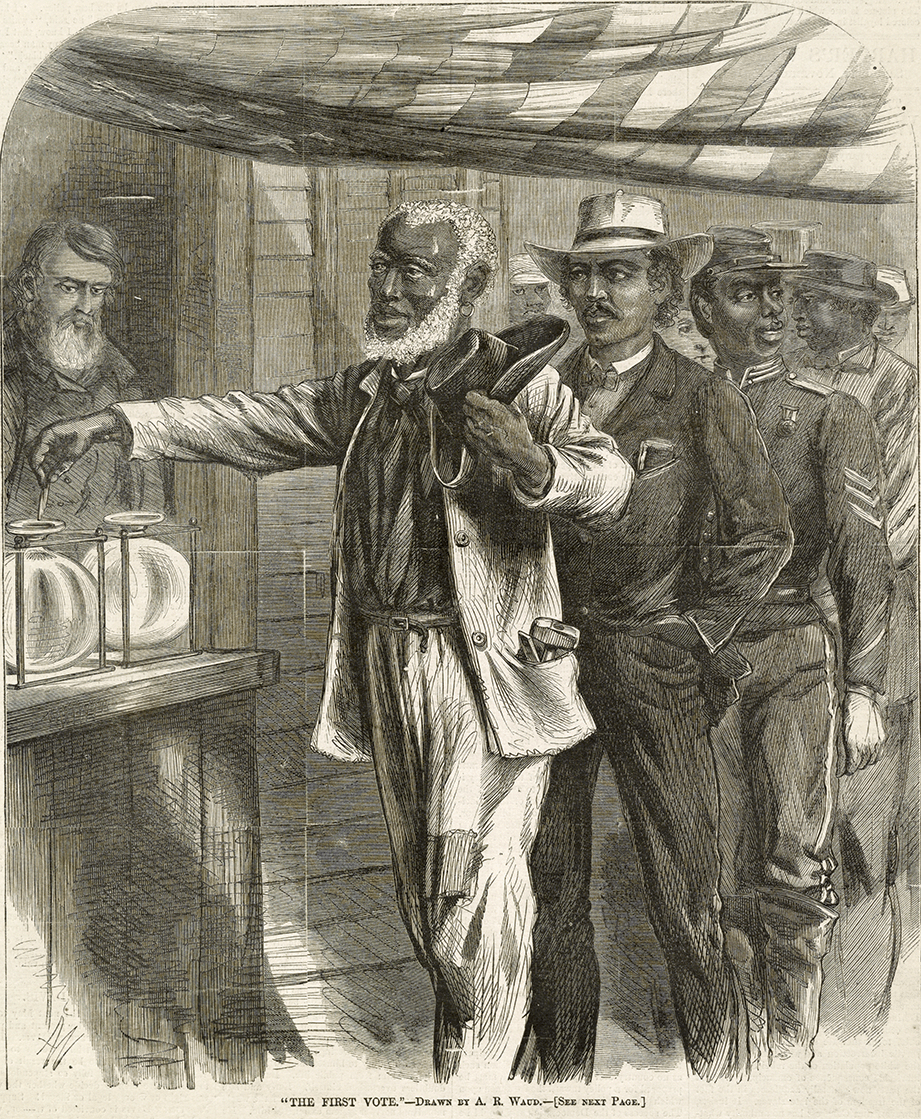
Black-and-white illustration titled “The First Vote,” showing an African American man casting a ballot while white officials and uniformed soldiers stand nearby, observing the voting process during Reconstruction.
Alfred R. Waud, “The first vote,” Harper’s Weekly, illustration, 
(1867 November 16), from Library of Congress Prints 
and Photographs Online Catalog


The Louisiana Constitutional Convention of 1868[14] included 49 Black men and 49 white men. They created the progressive Louisiana Constitution of 1868[15]. The constitution granted voting rights for freed men, racially integrated public schools, and permitted people to hold public office without owning property. Additionally, it strengthened the property rights of married women, provided for state care of the mentally and physically impaired, and ended imprisonment for debt. 

Louisiana citizens voted to approve the constitution in April 1868. However, half of the men in Louisiana could not vote because of their participation in the Confederacy. Some feared that former Confederates would overturn the constitution as soon as they could vote again.

After creating their new constitution and ratifying the 14th Amendment in July 1868, Louisiana was readmitted to the Union. The 15th Amendment[16], ratified in 1870, made universal male suffrage a national law, declaring that the right to vote could not be denied “on account of race, color, or previous condition of servitude.”  Women of any race were still banned from voting. Black men in Louisiana were elected to positions in local, state and national government in the 1870s. 

New laws and constitutional amendments created in the early years of Reconstruction had the potential to shift American society closer to racial equality. Black Americans pursued education, voted in elections, and ran for political office—rights they had previously been denied.  But would these changes be enough to end racial inequality?  

Purple rounded button with the word ‘PREV’ and a white left-pointing arrow.Purple rounded button with a white right-pointing arrow and the word ‘NEXT.’Purple rounded button with a white house icon and the word ‘HOME.’


Questions, Activity, & Citations

Critical Thinking Questions

1.  Where do you see connections between legislation of this period and public political action? How did these influence one another?

2.  When and where do you see examples of violent and nonviolent public action in this period? What were the effects of these actions? Can you think of other ways for members of the public to get involved in political issues?

3.  Do you agree with the requirements of the Reconstruction Acts for Southern states? Why or why not? Would you have suggested the federal government use different tactics to reconstruct the Southern states?

4.  Why do you think the Reconstruction Acts emphasized universal male suffrage—which is the right for all men to vote, regardless of race—in the process of readmitting states to the union? Who is excluded from universal male suffrage? What is your opinion of Congress’s decision to deny the vote to former Confederates and their supporters while they advocating for universal male suffrage? 

5.  What was the significance of the Louisiana Constitutional Convention and new state Constitution of 1868?

Footnote Citations

[1] Acts Passed by the General Assembly of the State of Louisiana, Act No. 16, New Orleans: J.O. Nixon State Printer, 1866. John Minor Wisdom Collection, 1710-1960, Manuscripts Collection 230, Box 13, Louisiana Research Collection, Tulane University. https://library.search.tulane.edu/discovery/delivery/01TUL_INST:Tulane/12434206700006326

[2] Alfred R. Waud, “Scenes in Memphis, Tennessee, during the riot,” Harper’s Weekly, illustration, (1866 May 26), from Library of Congress Prints and Photographs Online Catalog, https://www.loc.gov/pictures/resource/cph.3c11152/ 

[3] L’Union, 1862-1864, (New Orleans, LA), Library of Congress Serial and Government Publications Division, https://www.loc.gov/item/2013254046/ 

[4] New Orleans Tribune, 1864-1869, (New Orleans, LA). Library of Congress Serial and Government Publications Division, https://www.loc.gov/item/sn83016710/ 

[5] Lilienthal’s Photographic Establishment, “Mechanic’s Institute, New Orleans, Louisiana,” stereograph, between 1860 and 1870, from Library of Congress Pints and Photograph Division, https://www.loc.gov/pictures/item/89709171/

[6] Theodore R. Davis, “The Freedmen’s procession marching to the institute – the struggle for the flag,” Harper’s Weekly, illustration, (1866 August 25), from Library of Congress Prints and Photographs Online Catalog, https://www.loc.gov/pictures/item/94510091/

[7] Theodore R. Davis, “The riot in New Orleans,” Harper’s Weekly, illustration, August 25, 1866, from Library of Congress Prints and Photographs Online Catalog, http://hdl.loc.gov/loc.pnp/cph.3c38353 

[8] “The Thirtieth of July,” The New Orleans Tribune, (New Orleans, LA), July 30, 1867, Library of Congress Serial and Government Publications Division, https://www.loc.gov/resource/sn83016710/1867-07-30/ed-1/?sp=3&st=image

[9] “State of the City and Result of the Conflict,” New Orleans Daily Crescent, (New Orleans, LA), August 1, 1866, Library of Congress Serial and Government Publications Divisionhttps://www.loc.gov/item/sn82015753/1866-08-01/ed-1/

[10] United States Congress, House. Select Committee On The New Orleans Riots, Thomas D Eliot, Samuel Shellabarger, Benjamin M Boyer, and United States Congress. Report of the Select committee on the New Orleans Riots, Washington, Gov't print. off, 1867, Library of Congress, https://www.loc.gov/item/07021382/

[11] U.S. Congress, “Chapter CLIII – An Act to provide for the more efficient Government of the Rebel States,” U.S. Statutes at Large, Volume 14 -1867, 39th Congress, Periodical, from Library of Congress, https://www.loc.gov/resource/llsalvol.llsal_014/?sp=460&st=image&r=0.268,0.547,0.95,0.5,0

U.S. Congress, “Chapter VI – An Act supplementary to an Act entitled “An Act to provide for the more efficient Government of the Rebel States,” passed March second, eighteen hundred and sixty-seven, and to facilitate Restoration,” U.S. Statutes at Large, Volume 15, 1867-1869, 40th Congress, periodical, from the Library of Congress, https://www.loc.gov/resource/llsalvol.llsal_015/?sp=36&r=-1.209,-0.522,3.419,1.8,0

U.S. Congress, “Chapter XXV – An Act to amend the Act passed March twenty-third, eighteen hundred and sixty-seven, entitled “An Act supplementary to “An Act to provide the more efficient…,” U.S. Statutes at Large, Volume 15, 1867-1869, 40th Congress, periodical, from the Library of Congress, https://www.loc.gov/resource/llsalvol.llsal_015/?sp=75&st=image&r=0.092,0.494,0.826,0.636,0

[12] U.S. Constitution, amendment 14, National Archives, archives.gov, https://www.archives.gov/milestone-documents/14th-amendment

[13] Alfred R. Waud, “The first vote,” Harper’s Weekly, illustration, (1867 November 16), from Library of Congress Prints and Photographs Online Catalog, https://www.loc.gov/pictures/item/94510091/    

[14] “Extract from the reconstructed Constitution of the state of Louisiana, with portraits of the distinguished members of the Convention & Assembly, A.D. 1868,” lithograph, (1868), from Library of Congress Prints and Photographs Online Catalog, https://www.loc.gov/pictures/item/98514397/

[15] Constitution adopted by the State Constitutional Convention of the state of Louisiana, March 7. New Orleans, Printed at the Republican Office, 1868, from Library of Congress, https://www.loc.gov/item/01018727/

[16] U.S. Constitution, amendment 15, National Archives, archives.gov, https://www.archives.gov/milestone-documents/14th-amendment


Reconstruction in Louisiana
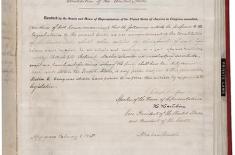
The House Joint Resolution Proposing the 13th Amendment to the Constitution, January 31, 1865; Enrolled Acts and Resolutions of Congress, 1789-1999; General Records of the United States Government; Record Group 11; National Archives.

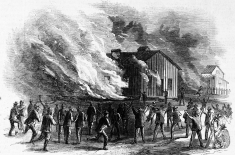
Introduction to Reconstruction in Louisiana

Black-and-white 19th-century-style engraving depicting a crowd of men gathered around a wooden building that is engulfed in flames. Thick smoke billows into the sky as the fire spreads. Several figures in the foreground raise their arms or gesture toward the blaze, while others run or stand watching. Additional structures appear in the background, suggesting a town or settlement. The scene conveys chaos and urgency as the fire consumes the building.

Early Reconstruction: Shifting Power, New Laws, and Racial Tensions, 1866–1870

Black-and-white photograph of a row of butchers standing outside their stalls at the French Market in New Orleans. The men wear white aprons and stand beneath a covered arcade with arched openings and exposed beams. Meat hangs in the foreground, and a few women and a child stand farther down the walkway.

Late Reconstruction: Tested Amendments, Disputed Elections, and Continued Violence, 1870–1877

Political cartoon showing two hands clasped over a revolver resting on scattered papers with phrases about “civil war,” “fraud,” and “violence.” The imagery suggests a tense truce or uneasy agreement following conflict.

Post-Reconstruction: Segregation, Activism, and the Courts, 1877–1896

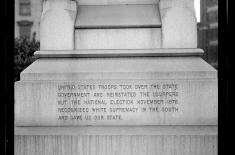
Black-and-white photograph of the base of a stone monument with an engraved inscription. The text states that U.S. troops took over the state government during Reconstruction and claims that the 1876 national election “recognized white supremacy in the South.” The carved message reflects a Lost Cause interpretation of events.

Conclusion: Rise of Jim Crow and the Legacy of Reconstruction

Funded by a grant from the Library of Congress Teaching with Primary Sources program. Content created and featured in partnership with the TPS program does not indicate an endorsement by the Library of Congress.