Post-Reconstruction: Segregation, Activism, and the Courts

1877–1896

Online Exhibitions


The end of Federal Reconstruction had severe consequences. As white Democrats took back control of the southern states, they tried to erase the social progress made by Black Americans. Racially discriminatory laws increased, known as “Jim Crow” laws, in reference to a character that white actors performed to mock and demean Black people. Despite the work of Black activists, Jim Crow laws spread across Louisiana and throughout the South after Reconstruction.

Compromise of 1877

A messy presidential election brought about the end of Federal Reconstruction. In 1876, Republican Rutherford B. Hayes and Democrat Samuel J. Tilden ran for president. White Southern Democrats supported Tilden, and he won the popular vote. But neither candidate had enough electoral votes to win. Four states including Louisiana had disputed votes. These states sent two sets of conflicting electoral votes to Congress. Each party claimed victory and accused the other of voter fraud, intimidation, and bribery. To settle the dispute, Congress created a committee[1] of senators, representatives, and Supreme Court justices to decide the electoral votes from these states. The commission was supposed to include seven Democrats, seven Republicans, and one Independent. However, the Independent member did not participate and another Republican was appointed. 
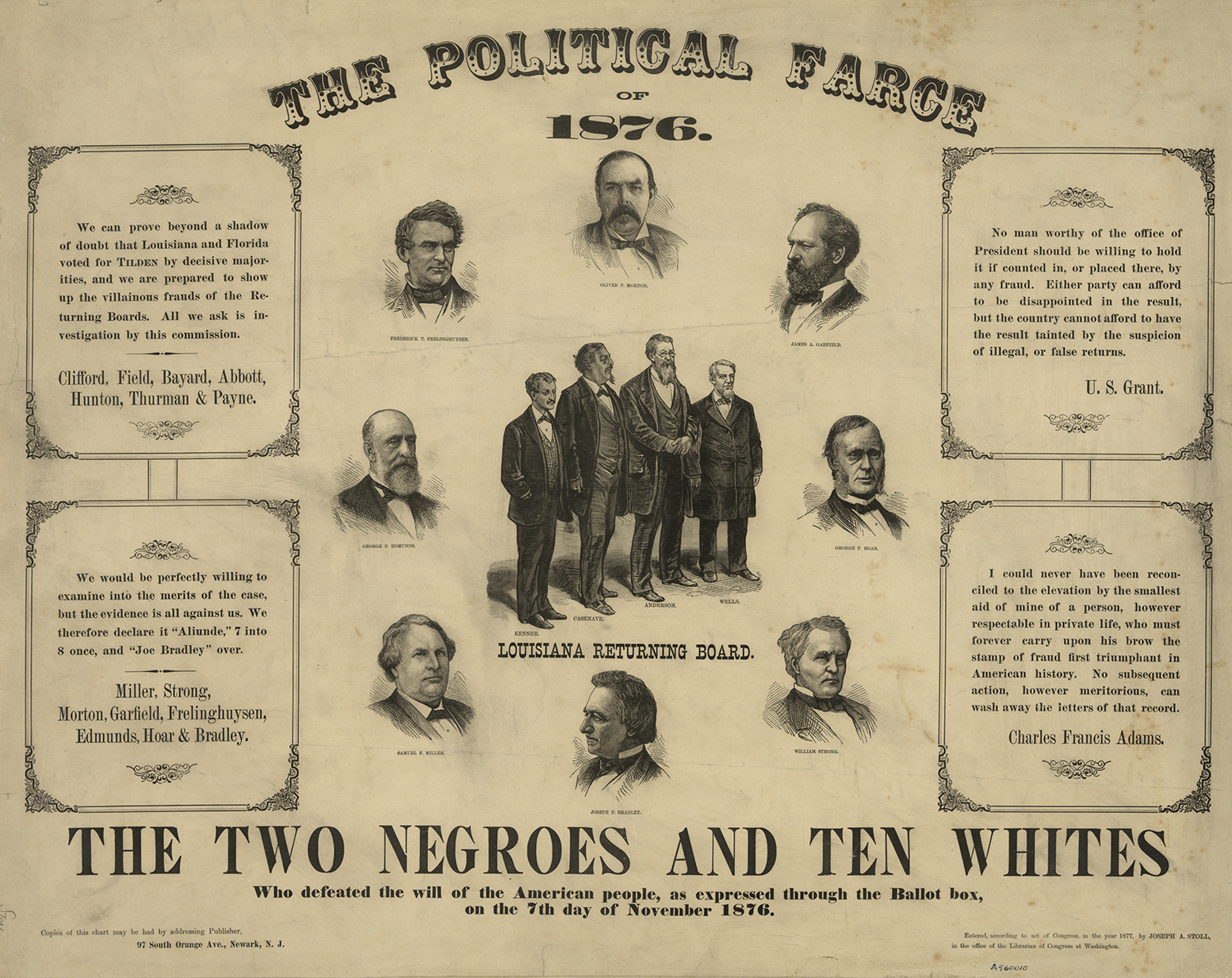
Printed poster titled “The Political Farce of 1876,” featuring portraits of political figures surrounding a central group labeled “Louisiana Returning Board.” Text panels criticize election results, with a large caption at the bottom using racist language to describe the outcome.
The political farce of 1876,” published by Joseph A. Stoll, 
1877, (Newark, NJ), print, lithograph, Library of Congress 
Prints and Photographs Division


The commission voted along party lines. With one more Republican than Democrat, they granted all the contested electoral votes to Hayes[2]. Democrats across the South were outraged[3]. They threatened violence against the government. A deal was made through backroom negotiations[4]. If Democrats would agree to Hayes becoming president, Republicans would withdraw all federal troops[5] from the South. This agreement, known as the Compromise of 1877[6], ended federal Reconstruction.  
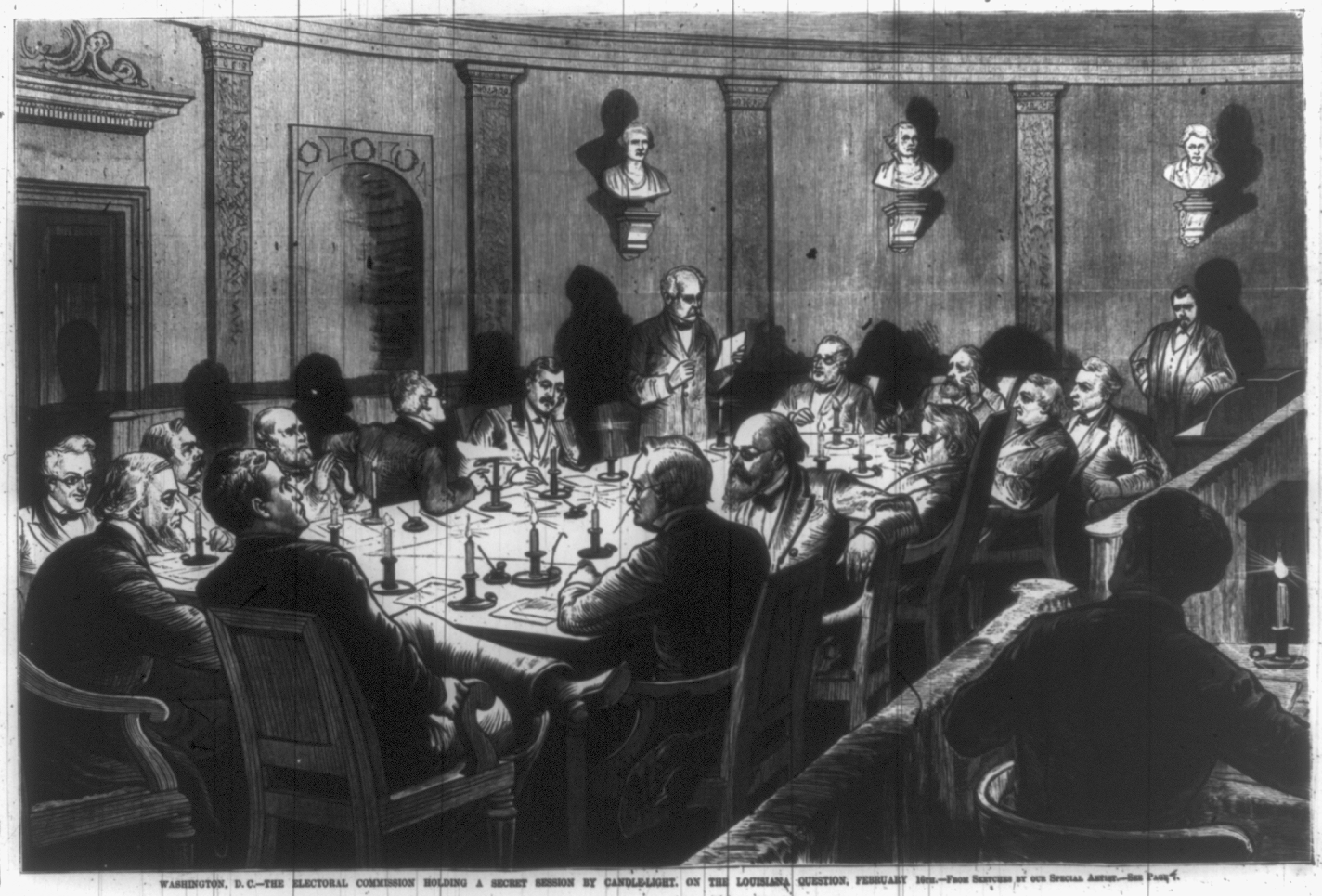
Black-and-white illustration of a formal meeting room where a group of men sit around a table lit by candles. One man stands reading a document while others listen, representing a deliberative session related to the Louisiana election dispute.
“Electoral Commission meeting in secret session by candlelight,” 
Frank Leslie’s Illustrated Newspaper,  March 10, 1877, microfilm reproduction 
of wood engraving, Library of Congress Prints and Photographs Division
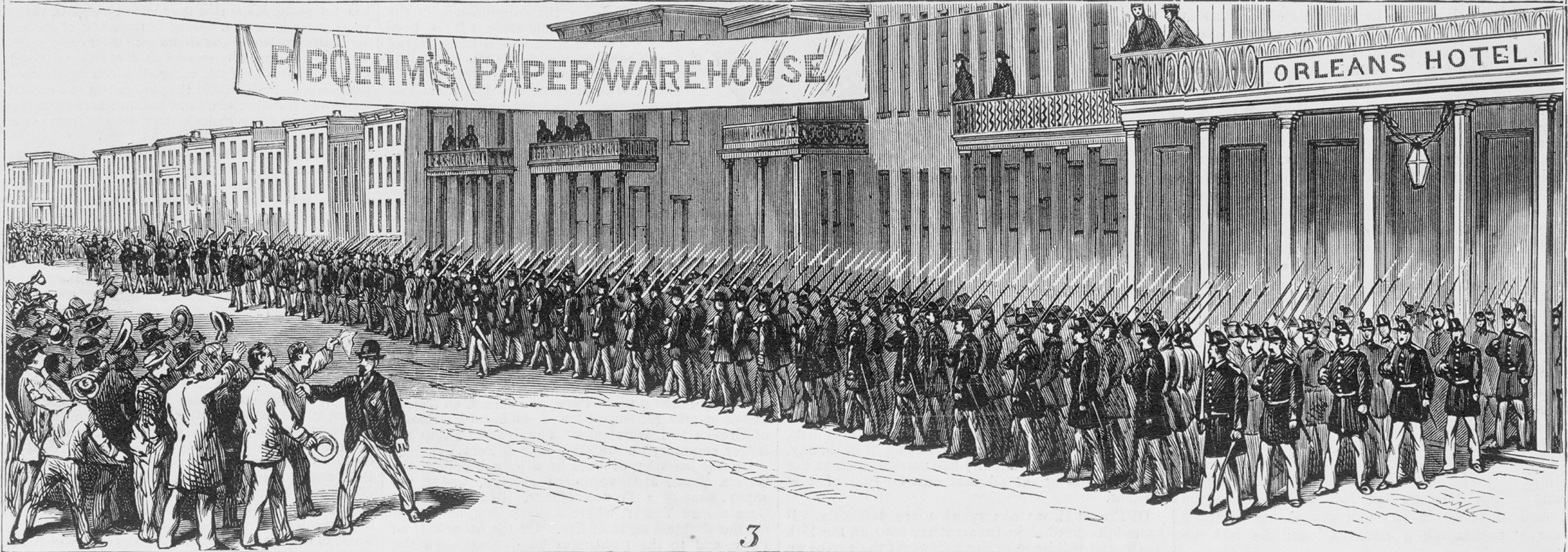


Illustration of a long line of armed soldiers standing in formation along a New Orleans street near buildings labeled “Orleans Hotel” and “A. Boeuf’s Paper Warehouse.” Civilians gather at the left, gesturing toward the troops, while onlookers watch from balconies above.
“Louisiana—the withdrawal of the federal troops from the State 
House in new Orleans, at noon, on April 24th,” Frank Leslie’s Illustrated 
Newspaper, May 19, 1877, print, wood engraving, Library of Congress
 Prints and Photographs Division
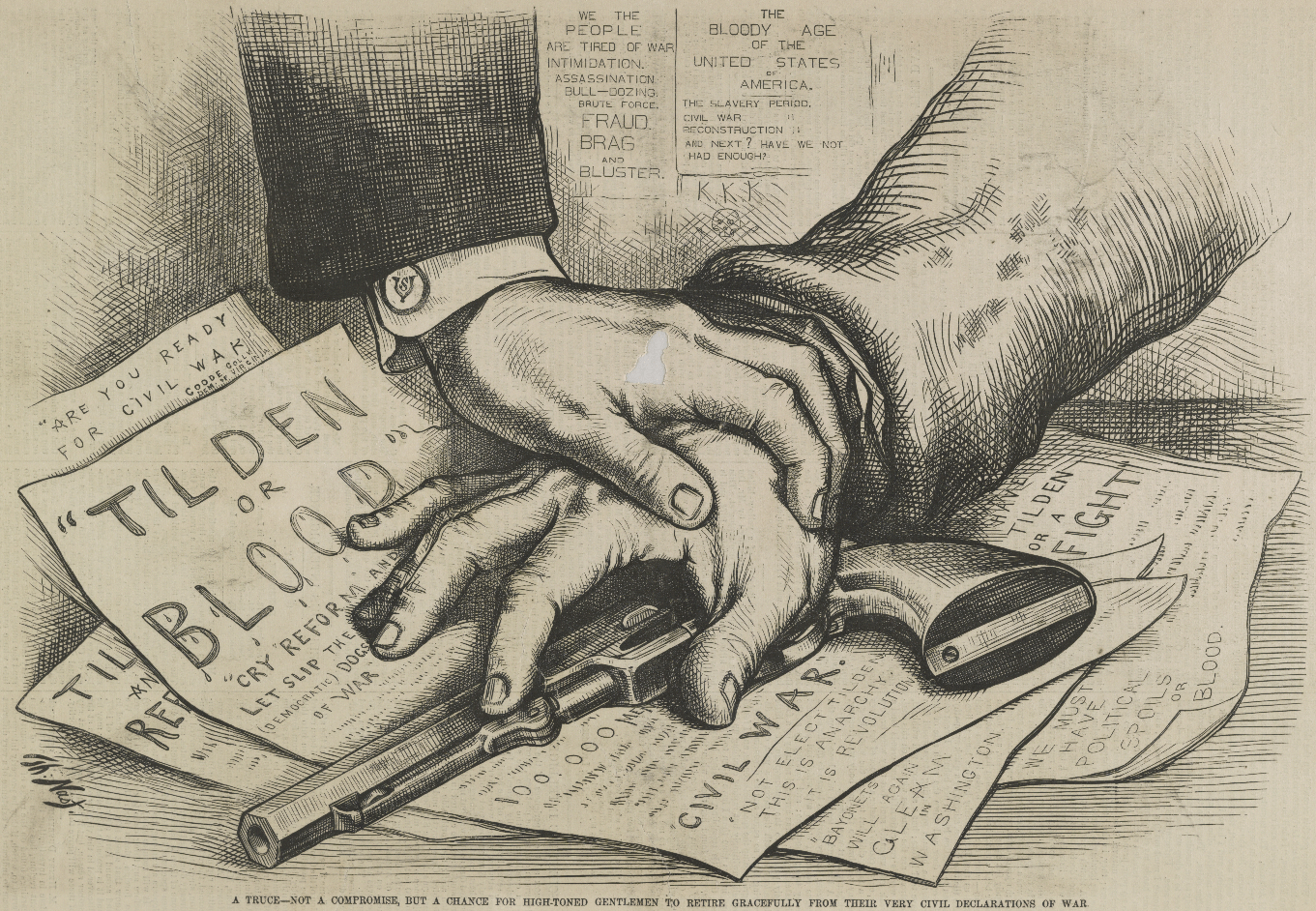
 

Political cartoon showing two hands clasped over a revolver resting on scattered papers with phrases about “civil war,” “fraud,” and “violence.” The imagery suggests a tense truce or uneasy agreement following conflict.
Thomas Nast, “A truce—not a compromise, but a chance for high-toned gentlemen to retire 
gracefully from their very civil declarations of war,” Harper’s Weekly, February 17, 1877, 
print, wood engraving, Library of Congress Prints and Photographs Division


Hall v. Decuir, The Citizens’ Committee, and Plessy v. Ferguson

One way that Black Americans advocated for their rights was by challenging the increasing number of racial segregation laws and practices in courts. The 1878 U.S. Supreme Court case Hall v. Decuir[7] involved Josephine Decuir, a wealthy Black Creole woman, who was denied access to a first-class steamboat cabin because of her race. Decuir sued the steamboat captain, citing the 1868 Constitution of Louisiana which outlawed racial discrimination on transportation. She lost the case. Since the steamboat was traveling from Louisiana to Mississippi, the Supreme Court said the Louisiana nondiscrimination law interfered with federal control of interstate commerce. They argued that in the absence of federal law banning racial segregation, interstate transportation carriers could choose to segregate passengers by race. Their decision blatantly ignored the federal  Civil Rights Act of 1875[8]which prohibited racial discrimination in public accommodations but was frequently overlooked and rarely enforced. 

In 1891, Black civil rights activists in New Orleans organized a group called Comité des Citoyens, or the Citizens’ Committee[9]. Their goal was to fight the Louisiana Separate Car Act[10] of 1890, which required white and Black passengers to sit in separate railway cars. The group decided to deliberately break the law in order to challenge it in court. In February 1892, they chose Black activist and musician Daniel Desdunes to board a train from New Orleans to Mobile, Alabama and sit in the car for white passengers. He was arrested immediately. The Citizens’ Committee sued, and Criminal District Court Judge John Howard Ferguson ruled that Louisiana’s Separate Car Act could not be enforced on trains travelling between states because interstate travel was regulated by the federal government. Interestingly, this case used the same reasoning as Hall v. Decuir. Whether a Louisiana state law outlawed segregation as in Hall v. Decuir or required segregation as in the Desdunes case, it could not be enforced on interstate travel. 

The Citizens’ Committee celebrated their win. The Black newspaper The New Orleans Crusader[11]declared “Jim Crow is Dead.” They continued their strategy by challenging the legality of the Separate Car Act on travel within the state of Louisiana. In June 1892, the Citizens Committee sent Black activist and shoemaker Homer Plessy to sit in the “whites only” section of a train traveling from New Orleans to Covington, Louisiana. When he was arrested, Plessy and the Citizens’ Committee argued that the Act violated the 14th amendment, which granted all citizens equal protection under the law. Judge Ferguson, the same New Orleans judge who ruled in their favor before, heard the case. This time, Judge Ferguson ruled against them. He decided that the state had the right to segregate travel within Louisiana. The Louisiana Supreme Court upheld his decision. Plessy appealed to the U.S. Supreme Court, but they agreed with the lower courts. In their 1896 decision, they claimed that separating the races did not violate the 14th amendment if accommodations were equal. The phrase “separate but equal” was used as legal justification for racial segregation for the next sixty years. Plessy v. Ferguson[12] paved the way for more discriminatory Jim Crow laws across the United States. 

 

Purple rounded button with the word ‘PREV’ and a white left-pointing arrow.Purple rounded button with a white right-pointing arrow and the word ‘NEXT.’Purple rounded button with a white house icon and the word ‘HOME.’

Questions, Activity, & Citations

Critical Thinking Questions

1.  The Compromise of 1877 ended Federal Reconstruction. Do you think this was a balanced compromise between the Republican and Democratic parties? Would you have suggested a different compromise? Why?

2.  The contested 1876 presidential election involved an argument over electoral college votes. Can you think of similar disputes in presidential elections in recent years? How do these issues impact the public? 

3.  Purposely disobeying a law in order to challenge it—such as in the case of Plessy v. Ferguson—is a type of activism known as civil disobedience. What is your opinion of this behavior and why? Do you see any examples of civil disobedience in current activism in the United States?

4.  What role did the courts play in racial segregation laws? 

5.  In these court decisions, where do you see different interpretations of the division of power between state and federal laws? What are some current issues which raise similar arguments of divisions of power between federal and state governments? 

Footnote Citations

[1] Carpenter, Matthew Hale. Before the Commission for Counting Presidential Votes in the States Where There Are More Than One Return from the Electoral Colleges, [Washington, D.C., McGill & Witherow, printers, 1877], Library of Congress, https://www.loc.gov/item/09023715/

[2] Donnell, Henry Clay, and Britton & Rey, The presidential elections of the United States, [Washington: U.S. Election Map Co, 1877], map, Library of Congress Geography and Map Division, https://www.loc.gov/item/2012586608/

[3] “The political farce of 1876,” published by Joseph A. Stoll, 1877, (Newark, NJ), print, lithograph, Library of Congress Prints and Photographs Division, https://www.loc.gov/pictures/item/2006677483/

[4] “Electoral Commission meeting in secret session by candlelight,” Frank Leslie’s Illustrated Newspaper, March 10, 1877, microfilm reproduction of wood engraving, Library of Congress Prints and Photographs Division, https://www.loc.gov/item/2003662150/

[5] “Louisiana—the withdrawal of the federal troops from the State House in new Orleans, at noon, on April 24th,” Frank Leslie’s Illustrated Newspaper, May 19, 1877, print, wood engraving, Library of Congress Prints and Photographs Division, https://www.loc.gov/pictures/item/93505869/

[6] Thomas Nast, “A truce—not a compromise, but a chance for high-toned gentlemen to retire gracefully from their very civil declarations of war,” Harper’s Weekly, February 17, 1877, print, wood engraving, Library of Congress Prints and Photographs Division, https://www.loc.gov/pictures/item/93510088/

[7] Hall v. Decuir, 95 U.S. 485 (1877), U.S. Supreme Court, https://supreme.justia.com/cases/federal/us/95/485/

[8] An act to protect all citizens in their civil and legal rights, 43rd Congress of the United States, 1874, Senate.gov, https://www.senate.gov/artandhistory/history/common/image/Civil_Rights_Act_1875.htm

Thomas F. Bayard, Civil Rights. Washington, Govt. print. off, 1875, Library of Congress, https://www.loc.gov/item/09022699/

[9] Rodolphe Lucien Desdunes, “Reform at Home,” The New Orleans Crusader, October 17, 1891, Jstor, https://www.jstor.org/stable/community.31024893

[10] Acts Passed by the General Assembly of Louisiana 1890, Act No. 111, HathiTrust, https://babel.hathitrust.org/cgi/pt?id=osu.32437123304731&seq=165&q1=separate

[11] “Jim Crow is Dead,” The New Orleans Crusader, July 16, 1892, Jstor, https://www.jstor.org/stable/community.31024908

[12] Plessy v. Ferguson, 163 U.S. 537 (1896), U.S. Supreme Court, https://supreme.justia.com/cases/federal/us/163/537/


Reconstruction in Louisiana
The House Joint Resolution Proposing the 13th Amendment to the Constitution, January 31, 1865; Enrolled Acts and Resolutions of Congress, 1789-1999; General Records of the United States Government; Record Group 11; National Archives.

Introduction to Reconstruction in Louisiana

Black-and-white 19th-century-style engraving depicting a crowd of men gathered around a wooden building that is engulfed in flames. Thick smoke billows into the sky as the fire spreads. Several figures in the foreground raise their arms or gesture toward the blaze, while others run or stand watching. Additional structures appear in the background, suggesting a town or settlement. The scene conveys chaos and urgency as the fire consumes the building.

Early Reconstruction: Shifting Power, New Laws, and Racial Tensions, 1866–1870

Black-and-white photograph of a row of butchers standing outside their stalls at the French Market in New Orleans. The men wear white aprons and stand beneath a covered arcade with arched openings and exposed beams. Meat hangs in the foreground, and a few women and a child stand farther down the walkway.

Late Reconstruction: Tested Amendments, Disputed Elections, and Continued Violence, 1870–1877

Political cartoon showing two hands clasped over a revolver resting on scattered papers with phrases about “civil war,” “fraud,” and “violence.” The imagery suggests a tense truce or uneasy agreement following conflict.

Post-Reconstruction: Segregation, Activism, and the Courts, 1877–1896

Black-and-white photograph of the base of a stone monument with an engraved inscription. The text states that U.S. troops took over the state government during Reconstruction and claims that the 1876 national election “recognized white supremacy in the South.” The carved message reflects a Lost Cause interpretation of events.

Conclusion: Rise of Jim Crow and the Legacy of Reconstruction

Funded by a grant from the Library of Congress Teaching with Primary Sources program. Content created and featured in partnership with the TPS program does not indicate an endorsement by the Library of Congress.