Conclusion: Rise of Jim Crow and the Legacy of Reconstruction

Online Exhibitions


Reconstruction failed to achieve racial equality. Though it reunited the Southern and Northern states into one country after the American Civil War, citizens were divided by racism. The possibilities of equality introduced by Reconstruction were followed by intense backlash. This period was characterized by segregation laws, voter suppression, and violence against Black Americans. 

The Louisiana Constitution of 1898[1] mandated racially segregated public schools and severely restricted Black men’s right to vote, stripping away rights granted in the 1868 Constitution. In the decades after Reconstruction, public transportation, restaurants, hotels, and playgrounds were all segregated by race, with white people receiving priority and better facilities. Black men, and later Black women, were disenfranchised by strict voting requirements that included property ownership, poll taxes, and literacy tests.    

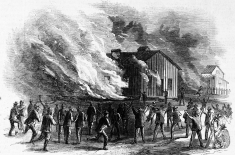
Emboldened by the removal of Federal Troops from the South,  white supremacist groups and racist mobs publicly murdered Black Americans in racial terror lynchings to threaten Black communities and coerce them into living under a racial hierarchy. Foreshadowed by violence such as the Mechanics Institute Massacre in 1866, white supremacists lynched more than 4,000 Black Americans in the southern states between 1877 and 1950—including 549 lynchings in Louisiana[2].
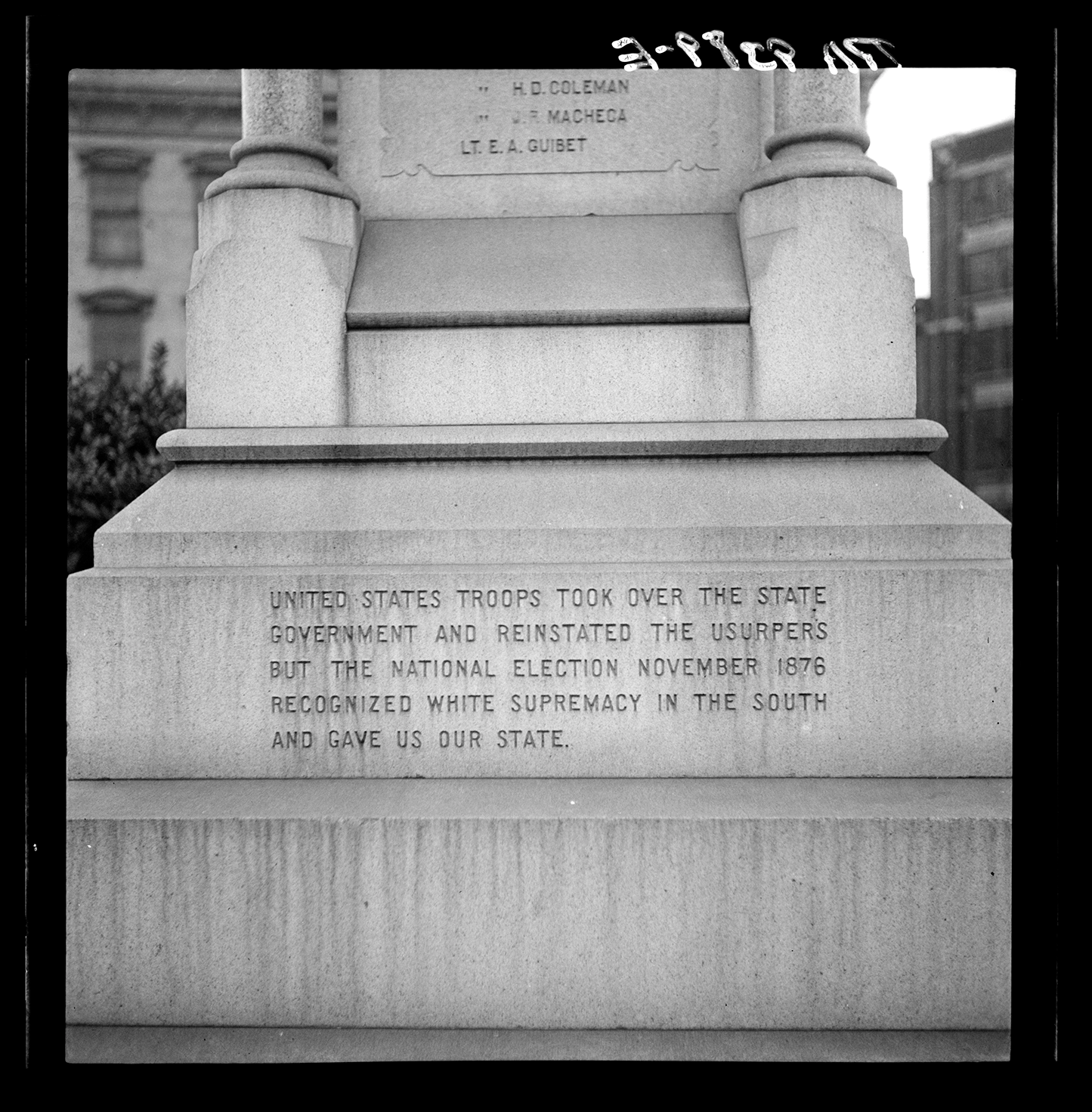
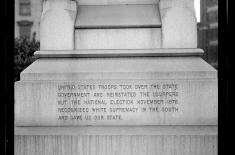
Black-and-white photograph of the base of a stone monument with an engraved inscription. The text states that U.S. troops took over the state government during Reconstruction and claims that the 1876 national election “recognized white supremacy in the South.” The carved message reflects a Lost Cause interpretation of events.
Dorothea Lange, “One side of the monument erected to race 
prejudice, New Orleans, Louisiana,” July 1936, photograph, 
Library of Congress Prints and Photographs Division


The backlash to Reconstruction was reflected in public memorials that honored the Confederacy as a noble “Lost Cause.” During the late 1800s and early 1900s, groups built monuments and memorials throughout the South that celebrated white supremacists. In New Orleans, groups of former Confederates and their sympathizers created the Battle of Liberty Place Monument in 1891[3]. In 1932, the city government commissioned a plaque[4] which was added to the monument and declared “United State Troops took over the state government and reinstated the usurpers but the national election of November 1876 recognized white supremacy in the south and gave us our state.” This blatantly racist monument was publicly displayed on city property until it was removed in 2017.

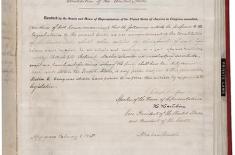
Black activists and their allies organized, protested, and advocated for their rights, securing several victories in the Civil Rights Movement of the1950s and 1960s. Segregation legalized in Plessy v. Ferguson was overturned by the Supreme Court in Brown v. Board of Education of Topeka, Kansas in 1954[5]. Advocacy by the National Association for the Advancement of Colored People (NAACP) laid the basis for this case. The U.S. Supreme Court decision ruled that racially segregated public schools were unconstitutional because it violated the equal protection clause of the 14th amendment—the same argument that the Citizens’ Committee made nearly sixty years before. The Civil Rights Act of 1964[6] outlawed discrimination in voting rights, accommodations, public facilities, education, and employment—which were many of the same rights that the Civil Rights of Act of 1875 granted but failed to enforce. 
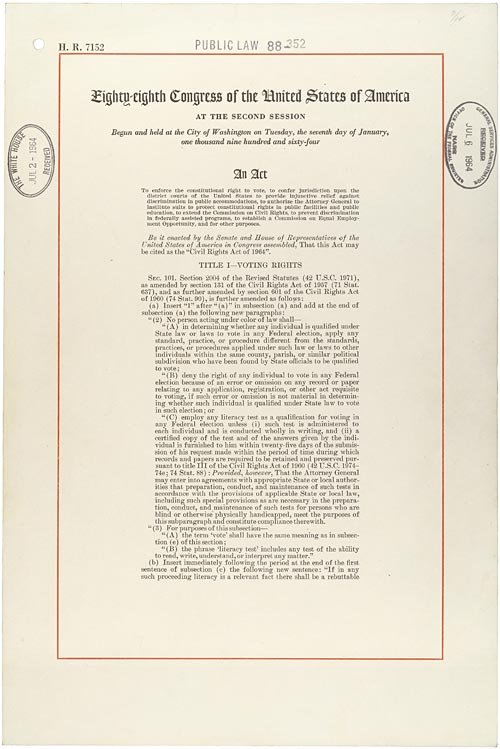
Photograph of a printed government document titled “Public Law 88-352,” identified as an act of the Eighty-eighth Congress of the United States, dated 1964. The page features formal text outlining provisions of the Civil Rights Act, including voting rights protections, with official stamps visible along the margins.
Civil Rights Act of 1964, Public Law 88-352, 78 STAT 241, 
July 2, 1964, National Archives and Records Administration
 

The Civil Rights Movement brought the Jim Crow era to an end and granted rights and protections for Black Americans—and all citizens—that were attempted during Reconstruction. Yet, there are ongoing conversations about how different groups experience unequal treatment in America today. Lessons from Reconstruction and its impacts can provide insights to current social issues in the United States.


 

Purple rounded button with the word ‘PREV’ and a white left-pointing arrow.Purple rounded button with a white house icon and the word ‘HOME.’


Questions & Citations

Critical Thinking Questions

1.  What was the immediate legacy of Reconstruction?

2.  How did people take action to engage with and influence the three branches of government during Reconstruction? Provide evidence. Do people engage with the government in the same or different ways today?

3.  How did anti-Black racism influence the events of Reconstruction? Where do you find evidence discriminatory attitudes in primary sources from this period? What current issues in the United States involve conversations around discrimination?

4.  In your opinion, in what ways are the events of Reconstruction still relevant today? What can Americans learn from Reconstruction?

Footnote Citations

Constitution of the State of Louisiana 1898, “Suffrage and Elections,” Articles 197-216, HathiTrust, https://babel.hathitrust.org/cgi/pt?id=hvd.hl47v7&seq=87

“Lynching in America: Confronting the Legacy of Racial Terror,” Equal Justice Initiative, 2017, https://eji.org/reports/lynching-in-america/ 

Gordon Chadwick, “The Creation of the Battle of the Liberty Place Monument,” New Orleans Historical https://neworleanshistorical.org/items/show/150?tour=8&index=2 

Dorothea Lange, “One side of the monument erected to race prejudice, New Orleans, Louisiana,” July 1936, photograph, Library of Congress Prints and Photographs Division, https://www.loc.gov/pictures/item/2017762996/ 

Brown v. Board of Education of Topeka, 347 U.S. 483 (1954), U.S. Supreme Court, https://supreme.justia.com/cases/federal/us/347/483/ 

Civil Rights Act of 1964, Public Law 88-352, 78 STAT 241, July 2, 1964, National Archives and Records Administration, https://www.archives.gov/milestone-documents/civil-rights-act


Reconstruction in Louisiana
The House Joint Resolution Proposing the 13th Amendment to the Constitution, January 31, 1865; Enrolled Acts and Resolutions of Congress, 1789-1999; General Records of the United States Government; Record Group 11; National Archives.

Introduction to Reconstruction in Louisiana

Black-and-white 19th-century-style engraving depicting a crowd of men gathered around a wooden building that is engulfed in flames. Thick smoke billows into the sky as the fire spreads. Several figures in the foreground raise their arms or gesture toward the blaze, while others run or stand watching. Additional structures appear in the background, suggesting a town or settlement. The scene conveys chaos and urgency as the fire consumes the building.

Early Reconstruction: Shifting Power, New Laws, and Racial Tensions, 1866–1870

Black-and-white photograph of a row of butchers standing outside their stalls at the French Market in New Orleans. The men wear white aprons and stand beneath a covered arcade with arched openings and exposed beams. Meat hangs in the foreground, and a few women and a child stand farther down the walkway.

Late Reconstruction: Tested Amendments, Disputed Elections, and Continued Violence, 1870–1877

Political cartoon showing two hands clasped over a revolver resting on scattered papers with phrases about “civil war,” “fraud,” and “violence.” The imagery suggests a tense truce or uneasy agreement following conflict.

Post-Reconstruction: Segregation, Activism, and the Courts, 1877–1896

Black-and-white photograph of the base of a stone monument with an engraved inscription. The text states that U.S. troops took over the state government during Reconstruction and claims that the 1876 national election “recognized white supremacy in the South.” The carved message reflects a Lost Cause interpretation of events.

Conclusion: Rise of Jim Crow and the Legacy of Reconstruction

Funded by a grant from the Library of Congress Teaching with Primary Sources program. Content created and featured in partnership with the TPS program does not indicate an endorsement by the Library of Congress.